
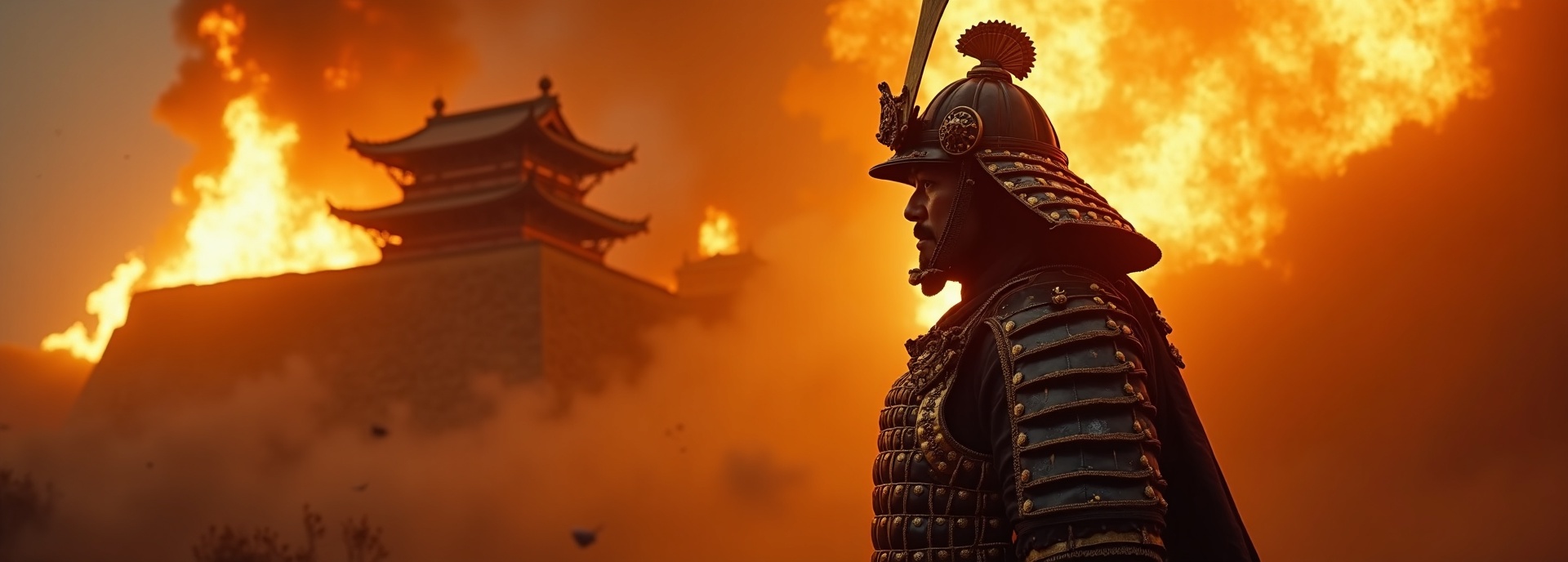
On the early morning of June 2, 1582 (Tenshō 10), the forces of Akechi Mitsuhide surrounded Honnō-ji temple in Kyoto. Oda Nobunaga—the man who had risen from a minor provincial lord in Owari to the brink of unifying all of Japan—met his end at the age of 49. In barely two decades, Nobunaga had overturned the political order of the Sengoku period through a combination of military innovation, economic reform, and ruthless determination. This article examines his methods through the lens of primary historical sources.
What You'll Learn in This Article
- Nobunaga's rise from a minor clan position to national dominance
- The real story behind the Battle of Okehazama (1560)
- How firearms and fortifications changed warfare at Nagashino
- The economic revolution of Rakuichi Rakuza (free markets)
- Primary source analysis: Shinchō Kōki, Frois, and official documents
- Common myths debunked with historical evidence
- Nobunaga's legacy and the unresolved mystery of Honnō-ji
Table of Contents
- 1. Historical Background & Power Dynamics
- 2. Nobunaga’s Profile & Character
- 3. Primary Sources: What the Records Tell Us
- 4. The Battle of Okehazama (1560)
- 5. Nagashino & the Firearms Revolution (1575)
- 6. Azuchi Castle & Economic Innovation
- 7. Common Myths Debunked
- 8. Legacy, Criticism & the Honnō-ji Mystery
- 9. Recommended Reading Guide
- 10. Key Terms Glossary
- 11. FAQ
1. Historical Background & Power Dynamics
When Nobunaga inherited leadership of the Oda clan in the early 1550s, Owari Province (modern western Aichi Prefecture) was far from a unified stronghold. His father,Oda Nobuhide, had been a capable warrior, but his death left the clan fractured. Nobunaga’s younger brother Nobuyuki (also called Nobukatsu) became a rallying point for rival factions within the family. The nominal provincial governor, the Shiba clan, had long since lost real power, and two branches of the Oda deputy‑governor family competed for influence. Nobunaga’s own branch—the Danjo‑no‑chū lineage—occupied a middle‑tier position in this hierarchy.
To the east loomed Imagawa Yoshimoto, who controlled the combined territories of Suruga, Tōtōmi, and Mikawa—a formidable three‑province coalition. To the north lay Mino Province under the Saitō clan. Nobunaga spent the years from roughly 1556 to 1558 suppressing internal opposition before he could even consider external expansion.
Across Japan, the post‑Ōnin War landscape (after 1467) had produced a generation of Sengoku daimyō—regional warlords who governed through military strength rather than imperial appointment. Takeda Shingen in Kai, Uesugi Kenshin in Echigo, and Mōri Motonari in the western provinces had all built powerful domains through conquest and shrewd governance. Nobunaga’s starting position was arguably weaker than any of them. This makes the question of how he overcame such disadvantages all the more compelling.
2. Nobunaga’s Profile & Character
| Item | Details |
|---|---|
| Lifespan | 1534 (Tenbun 3) – June 2, 1582 (Tenshō 10) |
| Birthplace | Owari Province (modern Aichi Prefecture). Birth castle debated: Nagoya Castle or Shobata Castle |
| Names & Titles | Childhood: Kipposhi. Common: Saburō. Court titles: Kazusa‑no‑suke (self‑claimed) → Danjo‑no‑chū → Gondainagon → Udaijin |
| Parents | Father: Oda Nobuhide. Mother: Tsuchida‑gozen |
| Major Battles | Okehazama (1560), Anegawa (1570), Nagashino (1575), Ishiyama Hongan‑ji Campaign (1570‑1580) |
| Key Policies | Rakuichi Rakuza (free markets), abolition of toll barriers, Azuchi Castle construction, land surveys (kenchi) |
In his youth, Nobunaga was reportedly called “Utsuke” (the Great Fool) due to his eccentric behavior. The Shinchō Kōki describes the young Nobunaga wearing outlandish clothing and eating fruit while walking through town— behavior considered scandalous for a lord’s heir. However, this “fool” image may contain literary embellishment. The author, Ōta Gyūichi, was Nobunaga’s retainer, and portraying the young lord as unconventional served to dramatize his later achievements.
What stands out most clearly from the sources is Nobunaga’s distinctive relationship with established authority. He initially supported Ashikaga Yoshiaki as shōgun to legitimize his march on Kyoto, but when Yoshiaki proved unwilling to serve as a puppet, Nobunaga expelled him in 1573. Toward the imperial court, Nobunaga accepted high‑ranking titles but ultimately resigned them—suggesting his ambitions extended beyond the existing political framework. What exactly he envisioned remains one of history’s great unanswered questions, cut short at Honnō‑ji.
3. Primary Sources: What the Records Tell Us
Shinchō Kōki (信長公記)
The most important primary source for Nobunaga’s life is the Shinchō Kōki, written by Ōta Gyūichi (also read as Ōta Ushi‑ichi). Ōta served as one of Nobunaga’s yūhitsu (secretaries/scribes) and recorded events based on personal observation and reports from others. The work comprises 16 volumes: a preface volume covering Nobunaga’s youth, followed by 15 chronological volumes documenting events after his entry into Kyoto.
The Shinchō Kōki is generally considered highly reliable, but it has limitations. As a retainer’s account, it may downplay events unfavorable to Nobunaga. It was compiled after Nobunaga’s death, and textual variations exist between different manuscript copies.
Nobunaga’s Official Documents
Another crucial source category is Nobunaga’s own correspondence and edicts—letters, vermillion‑seal documents, and proclamations preserved in temples, shrines, and daimyō archives across Japan. For example, the Kan’ō Rakuichi Rakuza edict of 1567 survives as a physical document, confirming that Nobunaga abolished guild monopolies and established free‑market zones in Mino Province.
Luis Frois’ Historia de Japam
The Jesuit missionary Luis Frois met Nobunaga personally and left detailed observations in his Historia de Japam (History of Japan). According to Frois, Nobunaga “did not venerate the gods or buddhas,” made decisions with extreme speed, and held his own judgment as absolute. These observations corroborate the image of a leader who prioritized rapid decision‑making and maintained skepticism toward religious authority.
However, Frois was a missionary with his own agenda. He viewed Nobunaga favorably because Nobunaga tolerated Christian proselytizing, and he was critical of Buddhist institutions that opposed the Jesuits. Every source reflects its author’s perspective — a principle essential to sound historical analysis.
4. The Battle of Okehazama (1560)
In May 1560 (Eirōku 3), Imagawa Yoshimoto led a massive army into Owari. The traditional account puts Imagawa’s forces at 25,000 against Nobunaga’s roughly 3,000, though recent scholarship suggests the Imagawa numbers may be exaggerated.
The conventional narrative describes a brilliant surprise attack— Nobunaga striking Yoshimoto’s headquarters during a rainstorm while the Imagawa forces rested. However, modern historians have questioned whether this was truly a premeditated ambush. The Shinchō Kōki’s own account does not clearly describe a flanking maneuver; some researchers now argue Nobunaga launched a frontal assault that happened to reach Yoshimoto’s command post through a combination of aggression and favorable conditions.
Regardless of the tactical details, the outcome is undisputed: Nobunaga killed the enemy commander‑in‑chief despite overwhelming numerical inferiority. This single battle transformed his political position entirely.
Strategic Insight: What matters most about Okehazama is not the battle itself but what Nobunaga did afterward. Rather than pursuing the collapsing Imagawa domain, he secured an alliance with Matsudaira Motoyasu (later Tokugawa Ieyasu) in the Kiyosu Alliance of 1562. By stabilizing his eastern border, he freed himself to concentrate all resources on conquering Mino to the north. This demonstrates a leader who prioritized strategic sequencing over opportunistic expansion.
5. Nagashino & the Firearms Revolution (1575)
At the Battle of Nagashino (Tenshō 3, 1575), the combined forces of Nobunaga and Tokugawa Ieyasu faced Takeda Katsuyori’s army at Shitaragahara. Nobunaga’s large‑scale deployment of firearms is well documented, but the popular image of “3,000 guns firing in three rotating volleys” is almost certainly a later invention (see Myths section below).
More significant than the number of guns was Nobunaga’s tactical framework. He constructed horse‑stopping palisades (uma‑yoke no saku) and prepared defensive positions, then waited for the Takeda cavalry to attack. This was a deliberate choice to fight a defensive battle of attrition— unusual for the era, when aggressive offense was the norm.
The combination of new technology (mass firearms) with a fundamentally redesigned tactical approach (defensive fortification) represents the core of Nobunaga’s military thinking. He didn’t simply adopt guns—he restructured how battles were fought around them.
6. Azuchi Castle & Economic Innovation
In 1576 (Tenshō 4), Nobunaga began construction of Azuchi Castle on the eastern shore of Lake Biwa. This was among the first Japanese castles to feature extensive stone walls and a multi‑story tenshu (tower keep). But Azuchi was far more than a fortress.
Nobunaga designed Azuchi as an integrated political, economic, and administrative center. He developed the castle town with widened roads, implemented Rakuichi Rakuza policies to attract merchants, and abolished toll barriers to facilitate trade. The castle represented a new model of governance—centralized authority combined with economic liberalization.
Rakuichi Rakuza: The Free Market Policy
Rakuichi (楽市, “free market”) abolished restrictions on who could sell goods in designated market areas. Rakuza (楽座, “free guilds”) eliminated the monopoly privileges of traditional merchant guilds (za). Together, these policies opened commerce to anyone willing to trade.
It’s important to note that Nobunaga did not invent this concept. The Rokkaku clan in Ōmi Province had implemented similar free‑market policies as early as 1549. Nobunaga’s contribution was not invention but systematic, large‑scale implementation as a core governance strategy. Recognizing good ideas and scaling them effectively is itself a form of strategic innovation.
Note: Azuchi Castle was destroyed shortly after the Honnō‑ji Incident in 1582. Much about its full design and layout remains unknown, though archaeological excavations continue to reveal new details.
7. Common Myths Debunked
Myth 1: “The Three‑Volley Rotation at Nagashino”
The famous image of 3,000 musketeers firing in three alternating rows is a product of Edo‑period military treatises and later popular fiction. The Shinchō Kōki records the large‑scale use of firearms but does not describe this specific three‑rotation tactic. Modern historians also question whether the number “3,000” is accurate, with some suggesting the actual count was considerably lower.
Myth 2: “Nobunaga Was an Atheist”
Frois’ description of Nobunaga as someone who “did not believe in gods or buddhas” has led to the popular image of Nobunaga as a complete atheist. However, historical records show he made offerings at Atsuta Shrine before Okehazama and participated in court religious ceremonies. What Nobunaga opposed was not religion itself but religious institutions wielding political and military power — particularly the Hongan‑ji’s Ikkō uprisings and the warrior monks of Mount Hiei.
Myth 3: “Nobunaga Invented Rakuichi Rakuza”
As noted above, the Rokkaku clan implemented free‑market policies in Ōmi Province around 1549—nearly two decades before Nobunaga’s documented Kan’ō edict of 1567. Nobunaga’s contribution was not invention but systematic, large‑scale implementation as a core governance strategy. Recognizing good ideas and scaling them effectively is itself a form of strategic innovation.
8. Legacy, Criticism & the Honnō‑ji Mystery
Shifting Historical Evaluations
Nobunaga’s reputation has shifted dramatically across eras. During the Edo period, he was viewed ambivalently—both as a tyrant who sought to usurp legitimate authority and as a visionary who paved the way for national order. The Meiji government, eager to promote modernization narratives, elevated him as a “reformer” figure. This “innovator” image has persisted into modern popular culture but deserves scrutiny.
Many of Nobunaga’s policies had precedents among contemporary daimyō. His true distinction lay not in the originality of individual policies but in his willingness to enforce them through overwhelming force and his speed of decision‑making.
The Dark Side: Violence and Suppression
Any honest assessment must confront Nobunaga’s extreme violence. The burning of Mount Hiei’s Enryaku‑ji temple complex in 1571 and the massacre of surrendered Nagashima Ikkō‑ikki rebels in 1574 shocked even contemporaries. Whether these acts represent “rational strategic calculations” or “excessive brutality” remains one of the most debated questions in Sengoku historiography.
The Honnō‑ji Mystery
Why did Akechi Mitsuhide betray Nobunaga? Theories abound: personal grudge, court conspiracy, involvement of Ashikaga Yoshiaki, dissatisfaction over Nobunaga’s Shikoku policy reversal, and many more. None has achieved consensus among historians because no definitive primary source explains Mitsuhide’s motivation. This remains one of the greatest unsolved mysteries in Japanese history.
The Unfinished Vision
Nobunaga’s project of national unification was completed by his successors: Toyotomi Hideyoshi and Tokugawa Ieyasu. The administrative, military, and economic frameworks Nobunaga established provided the foundation upon which they built. His story is not just about one man’s ambition—it is about how transformative visions, even when cut short, can reshape the trajectory of an entire nation.
9. Recommended Reading Guide
Beginner
- Shinchō Kōki (Modern Japanese translation by Nakagawa Taiko) — Accessible entry point to the primary source
- Jeroen Lamers, “Japanicus Tyrannus” — English‑language scholarly biography of Nobunaga
Intermediate
- Taniguchi Katsuhiro’s research series on Nobunaga (中公新書)
- Luis Frois, “Historia de Japam” (translated editions) — A European missionary’s firsthand account
Advanced
- Okuno Takahiro, “Study of Oda Nobunaga’s Documents” — Comprehensive collection and analysis of Nobunaga’s official correspondence
- Shinchō Kōki original manuscript variants — For comparing textual differences across copies
10. Key Terms Glossary
Rakuichi Rakuza (楽市楽座)
“Free markets, free guilds.” Rakuichi opened designated market areas to all traders. Rakuza abolished the monopoly privileges of traditional merchant guilds (za). Together, they created an environment of open commerce—comparable in concept to modern deregulation, though operating within a fundamentally different social structure.
Tenka Fubu (天下布武)
A phrase inscribed on Nobunaga’s personal seal, commonly translated as “spread military rule across the realm.” However, scholars debate whether “bu” (武) refers to raw military force or to the Confucian concept of “seven virtues of martial conduct”—an ideal of righteous governance. The scope of “tenka” (realm) is also debated: all of Japan, or just the Kinai (Kyoto region)?
Yūhitsu (右筆)
A secretary or scribe in samurai households responsible for drafting official documents. Ōta Gyūichi served in this capacity for Nobunaga, giving him direct access to information about his lord’s activities—but also creating a potential bias toward favorable portrayal.
11. Frequently Asked Questions
Q: Who was Oda Nobunaga and why is he important?
A: Oda Nobunaga (1534–1582) was a Japanese feudal lord who rose from a minor provincial position in Owari to become the dominant military and political force in Sengoku‑era Japan. He is considered the first of the three great unifiers of Japan, laying the groundwork later completed by Toyotomi Hideyoshi and Tokugawa Ieyasu. His innovations in military tactics, economic policy, and governance fundamentally reshaped Japanese society.
Q: What was the Battle of Okehazama?
A: The Battle of Okehazama (1560) was a decisive engagement where Nobunaga’s vastly outnumbered forces defeated the army of Imagawa Yoshimoto. This victory transformed Nobunaga from a regional lord into a major power. Whether it was a planned surprise attack or a bold frontal assault remains debated among historians.
Q: What was Rakuichi Rakuza?
A: Rakuichi Rakuza was an economic policy that established free markets and abolished guild monopolies. While not invented by Nobunaga (the Rokkaku clan implemented similar policies earlier), he applied it more systematically and broadly than any predecessor, making it a cornerstone of his territorial economic strategy.
Q: Why was Nobunaga killed at Honnō‑ji?
A: The exact motivation behind Akechi Mitsuhide’s betrayal remains unknown. Theories include personal resentment, court intrigue, involvement of the exiled shōgun Yoshiaki, and policy disagreements over Shikoku. No single theory has achieved scholarly consensus due to the lack of definitive primary evidence.
Disclaimer: This article is for informational and educational purposes. Historical interpretations are based on available primary sources and current scholarly consensus, which may evolve as new evidence emerges. Readers are encouraged to consult original sources and academic publications for deeper study.
Reference: This English article is based on research and the original Japanese article available at history-life.jp